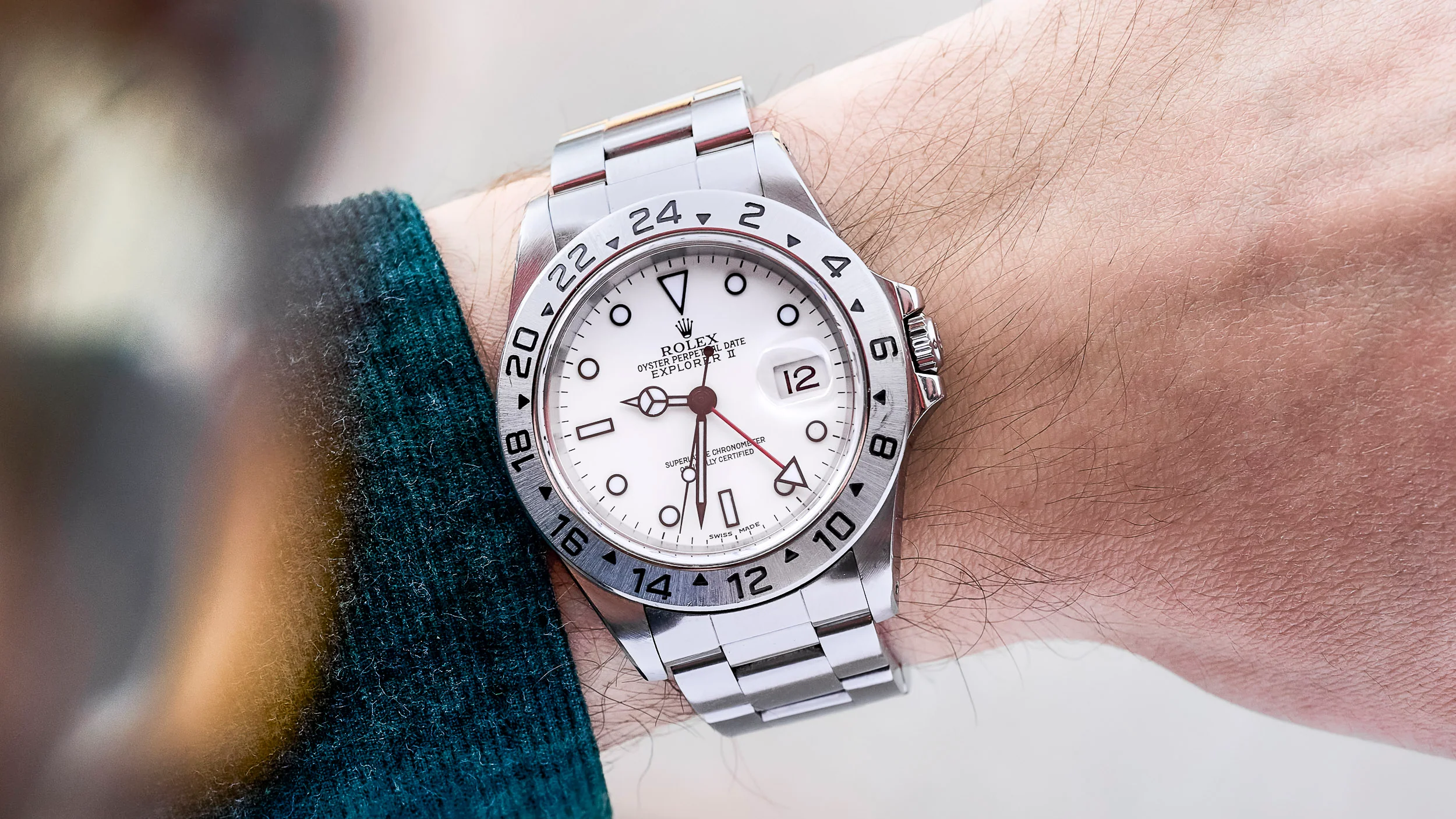
Today’s Rolexes are wearable but lean bulky and modern—too much for larger wrists. The neo-vintage versions are slimmer and more elegant, with the added bonus of a roughly USD 2,000 “discount” over current models.
This article makes the case for both Rolex Explorer I (214270) and Rolex Explorer II (16570). Both Neo-vintage, the first being produced from 2010 to 2021 and the later being produced from 1989 until 2011).
The numbers, briefly. Explorer I: the current 36 mm ref. 124270 is $8,450 retail (~11.5 × 43 mm), the current 40 mm ref. 224270 is $8,350 retail (11.6 × ~51 mm); the 214270 trades at $6,500–$8,000 pre-owned (~11.2 × 47.4 mm). Explorer II: the current 42 mm ref. 226570 is $10,600 retail (~12.4 × 50 mm); the 16570 trades at $7,000–$9,000 pre-owned (12.2 × 47 mm).
Why neo-vintage Rolex is a sweet spot
The term “neo-vintage” covers Rolex production roughly from 1990 to 2010. These watches share modern engineering — sapphire crystals, glossy dials, 904L steel, COSC-certified in-house movements like the Cal. 3130 and 3135 that ran for 30 years without complaint — while predating the design creep of the last decade (larger crowns, broader lugs, maxi dials, denser bracelets). They are old enough that the “new” premium has burned off, but too modern to be hunted as collector vintage. Both the Explorer 14270/114270 and Explorer II 16570 sit squarely in this band. Per ChronoPulse, the 16570 alone is up ~60% over the past five years as the market re-rates this era.
Dimensionally, this era was also Rolex’s slim period. The 36 mm Oyster Perpetual of the same years (refs. 14000 / 14200) was 36 × ~11 × ~43 mm — virtually identical to the Explorer 14270 case, and a useful benchmark for what “correctly proportioned Rolex” looked like before the modern thickening.
The 16570: the last 40 mm Explorer II
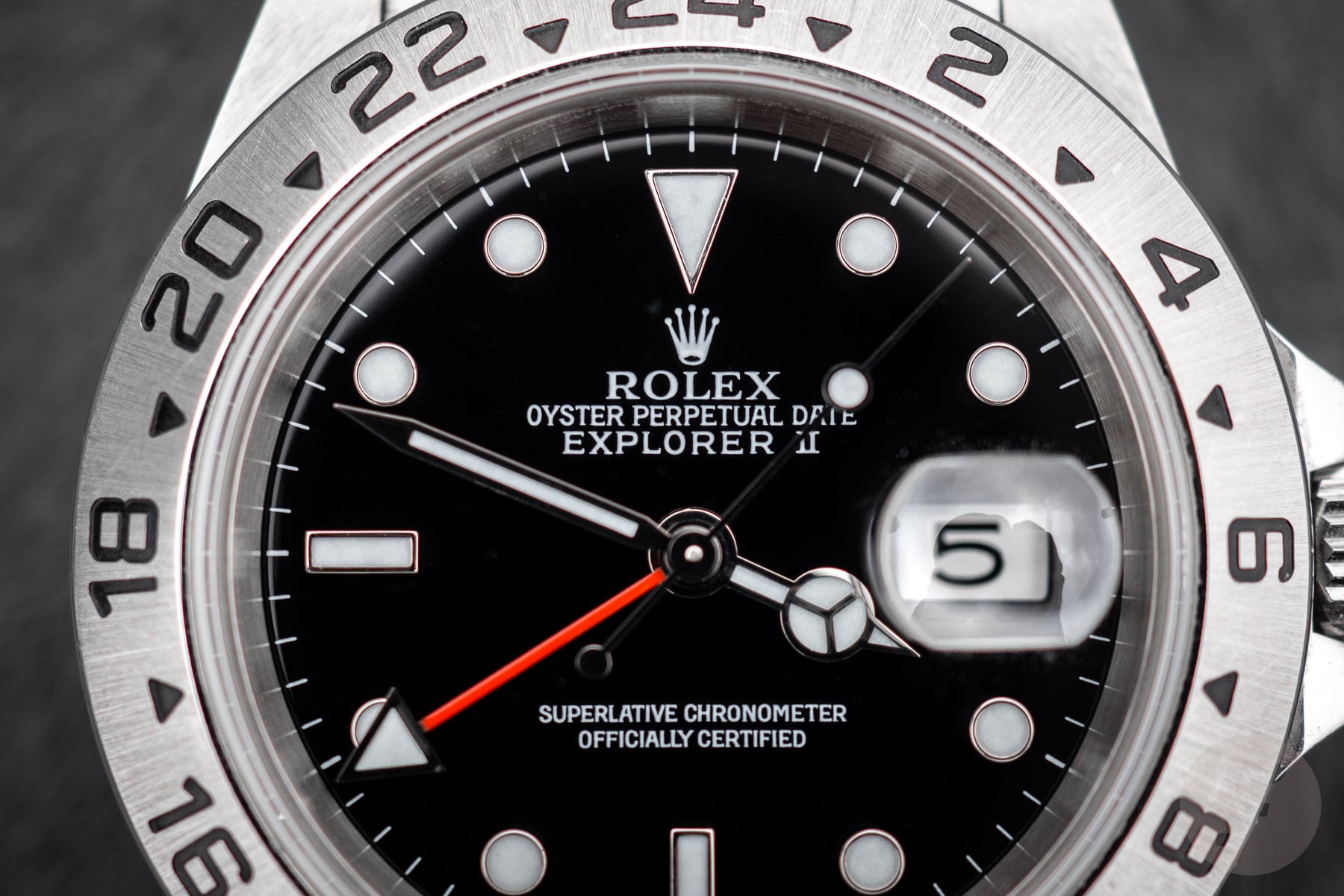
Twenty-two years in production — the longest of any Explorer II. Black or Polar dial, fixed 24-hour bezel, true GMT hand, Cal. 3185 (later 3186 with Parachrom). The case: 40 × 12.2 × 47 mm, 20 mm lugs. A fixed-bezel GMT with date and 100 m water resistance that slides under a shirt cuff. The 226570 that replaced it is 42 × ~12.4 × ~50 mm — small on paper, noticeably bigger on the wrist. Buyers who try both back to back regularly prefer the 16570, even knowing the 226570 has the 70-hour Cal. 3285 and Chromalight.
The 214270: the only 39 mm Explorer Rolex will ever make
The only 39 mm Explorer Rolex has ever made — and given the 2021 return to 36 mm and the 2023 jump to 40 mm, almost certainly the only one they ever will. The case: 39 × ~11.2 × ~47.4 mm, 20 mm lugs. The thickness is the spec most casually misreported. Tim Mosso measured it at 11.2 mm; Worn & Wound called it “a hint over 11 mm.” It is thinner than the current 124270 (~11.5 mm) and the 224270 (11.6 mm), thinner than every Explorer II ever made. This is the best-proportioned three-hand sport Rolex of the modern era.
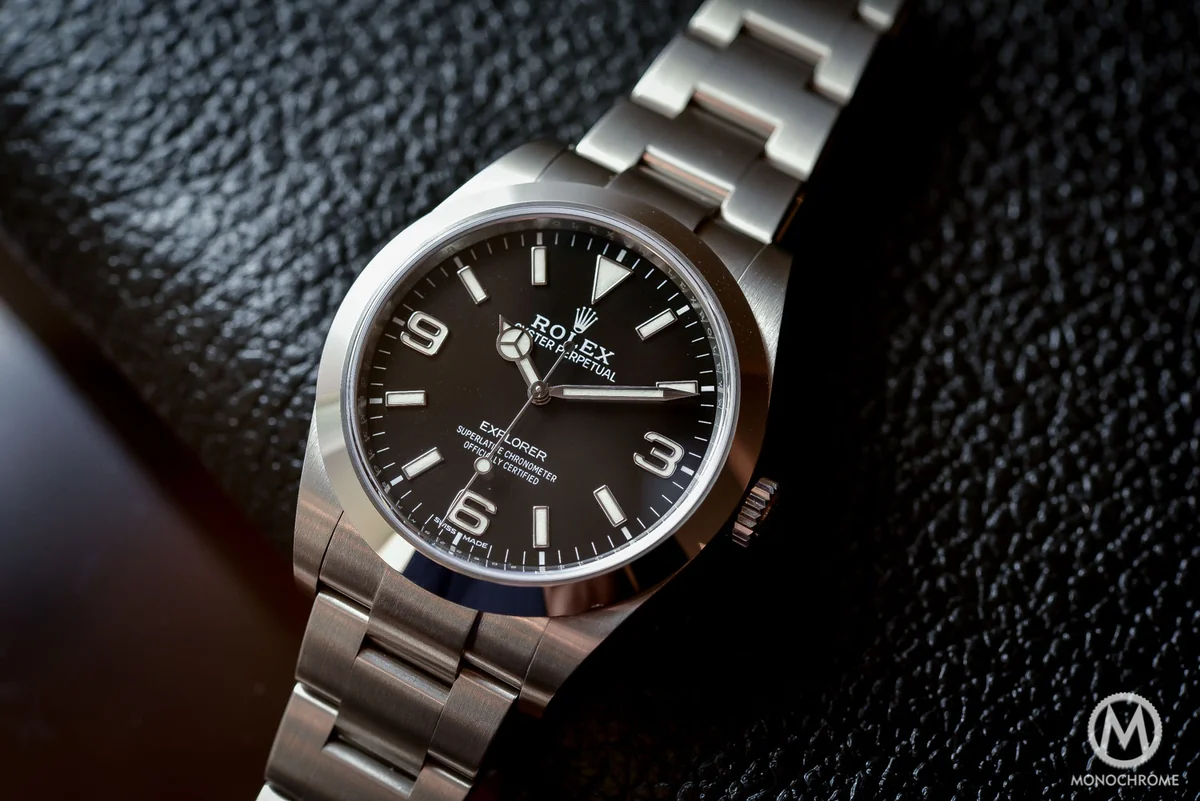
Two dial variants: the Mk1 (2010–2016) has unlumed white-gold 3-6-9 and a slightly short minute hand. The Mk2 (2016–2021) fixed both. Mk2 is the safer buy; Mk1 the more interesting collectible. Either trades below retail of any current Explorer.
Why thickness matters more than diameter
| Reference | Years | Diameter | Thickness | Lug-to-lug |
|---|---|---|---|---|
| Explorer I 114270 | 2001–2010 | 36 mm | ~11.2 mm | ~44 mm |
| Explorer I 214270 | 2010–2021 | 39 mm | ~11.2 mm | ~47.4 mm |
| Explorer I 124270 (current) | 2021– | 36 mm | ~11.5 mm | ~43 mm |
| Explorer I 224270 (current) | 2023– | 40 mm | 11.6 mm | ~51 mm |
| Explorer II 16570 | 1989–2011 | 40 mm | 12.2 mm | ~47 mm |
| Explorer II 226570 (current) | 2021– | 42 mm | ~12.4 mm | ~50 mm |
The 214270 at 11.2 mm is, surprisingly, thinner than the current Explorer 36 despite being larger across — the Cal. 3230 with Chronergy is slightly larger than the Cal. 3132 it replaced. Rolex didn’t make the 214270 slimmer by accident; they made the 124270 thicker by movement choice.
The verdict
The 16570 is for someone who wants a Rolex sport GMT and finds the 226570 too big. The 214270 is for someone who specifically wants a 39 mm sport Rolex and noticed there isn’t one in the current catalog. Closest alternatives outside Rolex: the Tudor Black Bay 58 GMT ($4,675, 39 × ~12 mm, METAS) for the 16570; the Tudor Ranger (~$3,300) or Omega Aqua Terra 38 ($6,800+, METAS) for the 214270. None are a Rolex — decisive or irrelevant depending on what you’re buying.
Both: watches Rolex has stopped making, in dimensions Rolex appears to have abandoned, at prices that have stopped speculating. That guy in 2001 wasn’t a genius. He was just early.
Prices and market data as of May 2026. Dimensional figures are widely reported collector and dealer measurements; Rolex does not publish official thickness specs. Sources: WatchCharts, Chrono24, Bob’s Watches, Worn & Wound, Monochrome, Teddy Baldassarre, WatchBox/Mosso, ChronoPulse.