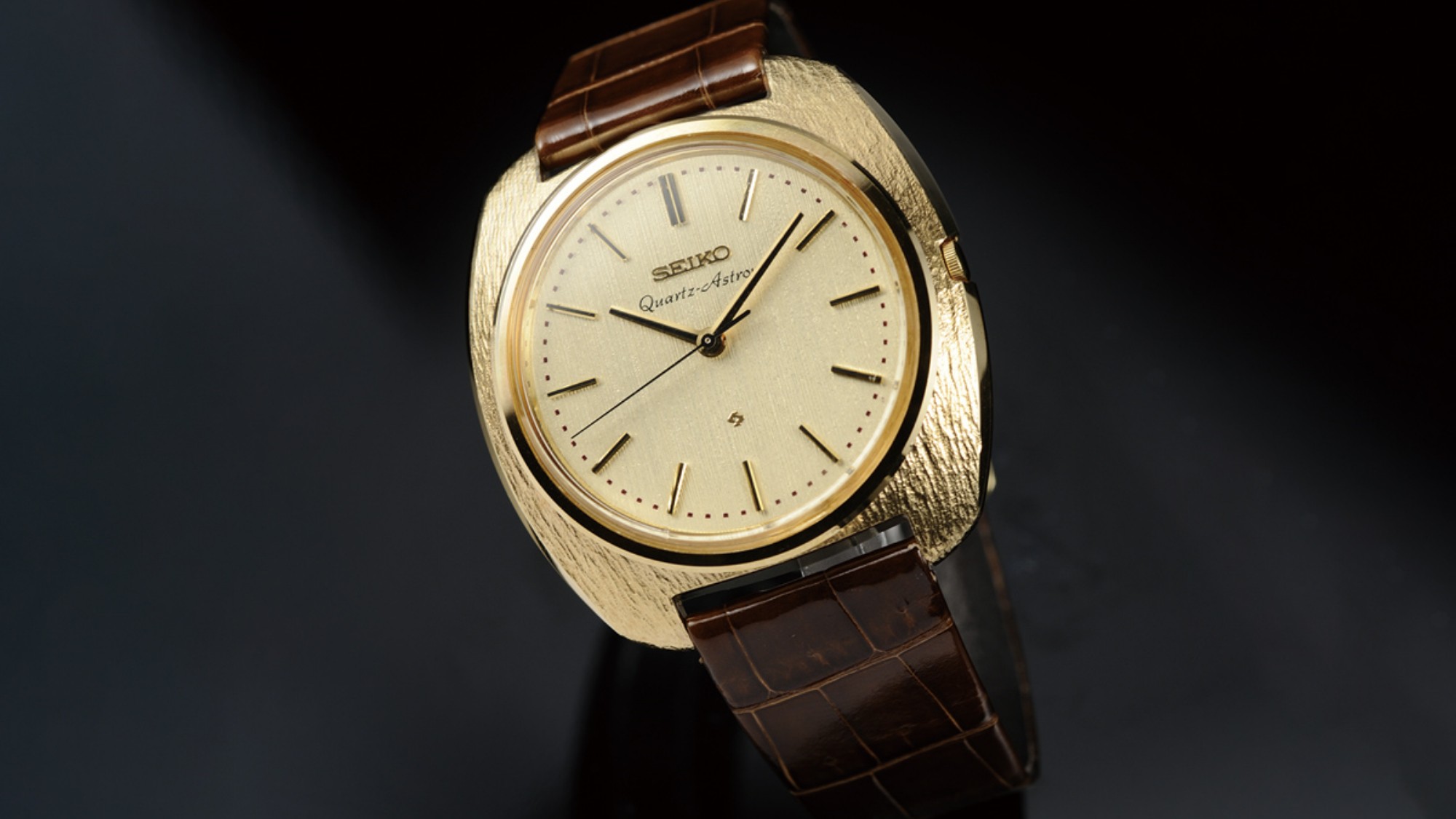
The Astron (25 December 1969)
On Christmas Day 1969, Seiko launched the Quartz Astron 35SQ in Tokyo: an 18-karat gold wristwatch, 36 mm, accurate to ±5 seconds per month — about 100 times better than the finest mechanical watch of the era. It cost 450,000 yen, roughly the price of a Toyota Corolla. Only a hundred or so were built in the first batch. The Astron itself was not a commercial threat — it was a luxury object — but it demonstrated that quartz worked, and Seiko’s president Shōji Hattori had ordered the patents released so the technology would spread. By the mid-1970s, Japanese and American manufacturers (Seiko, Citizen, Casio, Hamilton/Pulsar, Texas Instruments) had collapsed the cost of quartz components — integrated circuits, stepper motors, 32,768 Hz crystals — to a level the Swiss horizontal-division-of-labour cottage industry could not match. By 1978 a quartz watch cost less than a mechanical, was more accurate, and required no winding. The Swiss had actually developed competitive quartz technology (the Beta 21 caliber, shown at the 1970 Basel Fair by a 20-firm consortium), but treated it as a high-end novelty rather than the future.
The Damage (1970–1985)
The Swiss share of the global watch market fell from roughly 50% in 1970 to 24% by 1978. The number of Swiss watch firms collapsed from about 1,600 in 1970 to fewer than 600 by the mid-1980s. Swiss watch employment fell from 90,000 in 1970 to 28,000–33,000 by the mid-1980s — nearly two-thirds of the workforce gone. The dead included Universal Genève (whose Polerouter Genta had designed in 1954), Enicar (the brand that outfitted the 1956 Swiss Everest expedition), and dozens of smaller maisons that vanished without a buyer. In the United States the casualties were worse: by 1980, essentially every American watch firm had closed or been sold off, leaving only Timex and Bulova in recognisable form. Famous Swiss names that came within months of liquidation included Omega (losing roughly $50 million a year by the early 1980s), Longines, Tissot, Rado, Hamilton, Mido, and Certina — all owned by the two struggling holding groups SSIH and ASUAG. Blancpain ceased production entirely in 1971 and only existed as a dormant name. Breguet, bought by the Chaumet brothers from the Brown family in 1970, was producing about a hundred watches a year before being passed to Investcorp in 1987. Zenith survived only because foreman Charles Vermot hid the El Primero movement tooling in an attic when American owners Zenith Radio ordered it scrapped.
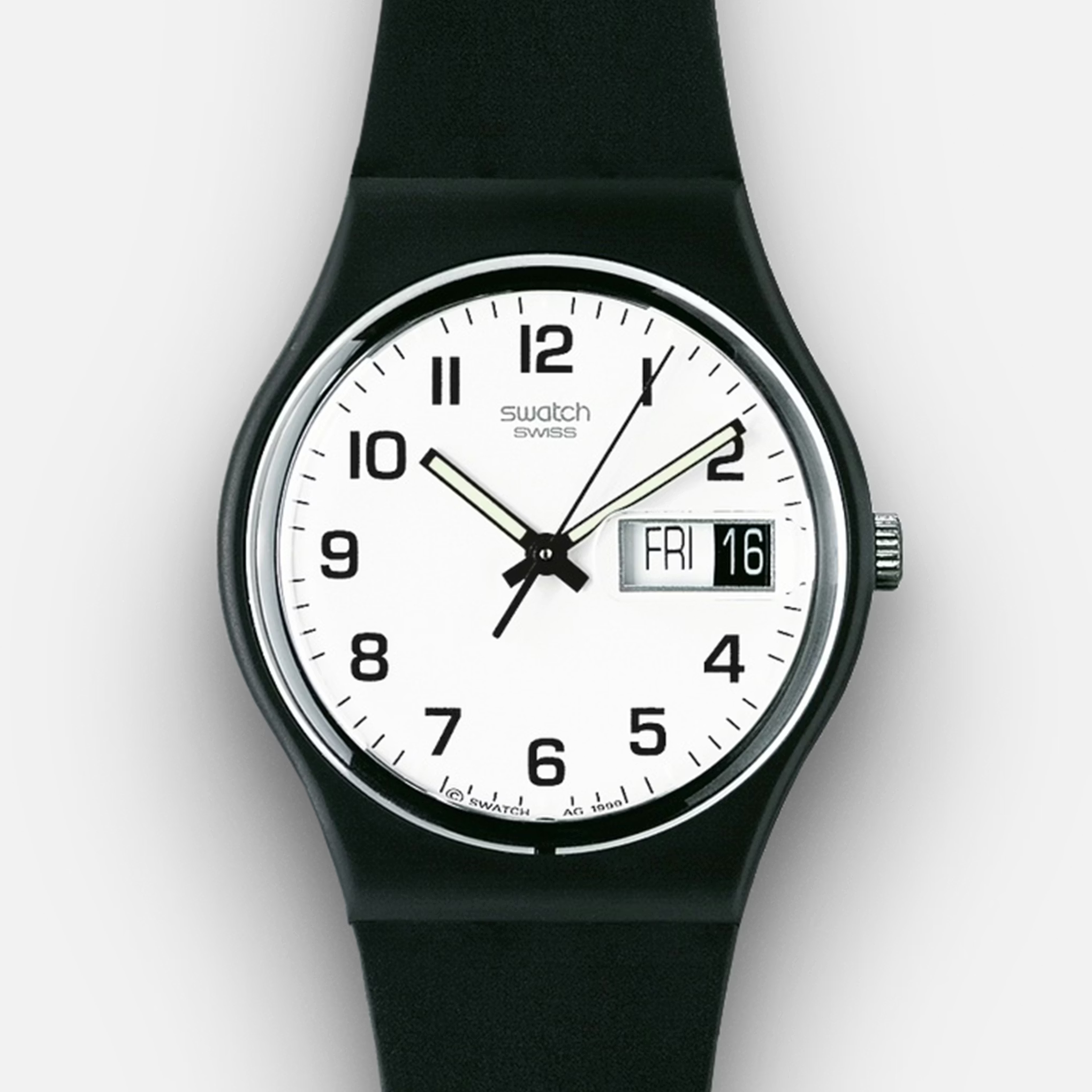
The Rescue: Hayek, SMH, and the Swatch (1983)
In the early 1980s a consortium of Swiss banks led by UBS, having extended SSIH and ASUAG enough credit to keep them alive, hired a Zurich management consultant named Nicolas G. Hayek (1928–2010) — Lebanese-born, of Greek Orthodox Christian background, married into a Swiss industrial family — to oversee what was expected to be the orderly liquidation of both groups. Foreign buyers, mostly Japanese, were already circling Omega, Longines, and Tissot. Hayek instead delivered what became known as the Hayek Study (1983), recommending the merger of ASUAG and SSIH into a single company, SMH (Société Suisse de Microélectronique et d’Horlogerie), and the launch of a cheap, high-volume, fully Swiss-made plastic quartz watch to compete head-on with the Japanese at the low end. Hayek put up roughly a third of his personal fortune, gathered a syndicate of Swiss investors, and took 51% control of SMH in 1985. The watch itself — designed by ETA engineers Elmar Mock and Jacques Müller, championed by ETA CEO Ernst Thomke — was the Swatch: 51 components instead of the usual 91+, fully automated production, launched in Zurich on 1 March 1983 in a first collection of twelve models. By the early 1990s nearly 100 million Swatches had been sold; one billion by 1995. The volume cash flow funded everything that came next. SMH (renamed Swatch Group in 1998) acquired Blancpain and Frédéric Piguet in 1992, Breguet in 1999, and Jaquet Droz, Glashütte Original, and Union Glashütte in 2000. Within five years of the merger, the group was the most valuable watchmaker in the world.
The Other Survival: Luxury Repositioning
Outside the Swatch system, the brands that survived did so by abandoning the idea that a watch should sell on accuracy. Rolex stayed almost entirely mechanical (the Oysterquartz, launched 1977, was a commercial misstep and discontinued in 2001), positioning itself instead on prestige, durability, and a controlled distribution network. Patek Philippe stayed mechanical and leaned into heritage. Audemars Piguet had been on the brink in 1972 when Gérald Genta’s Royal Oak — a steel sports watch priced like gold — proved a luxury mechanical could survive the quartz onslaught by becoming a status object. Across the industry the lesson was the same: a mechanical watch could no longer compete with quartz on time-telling, so it had to compete on craftsmanship, heritage, and emotion. The repositioning worked. By the early 2000s, with the quartz market commoditised and Hayek’s Swatch volume subsidising the rebuilt luxury maisons, Swiss watchmaking returned to the top of the global value chain — not by share of units sold, which it has never recovered, but by share of revenue, where it now dominates. The crisis killed roughly a thousand brands and two-thirds of the workforce. What emerged was a smaller, richer, more concentrated industry organised around three groups (Swatch, Richemont, LVMH) plus the independents — the structure we still live with today.